Vietnam robusta green coffee beans
Coffea canephoraGrade 1 S18 & S16Central Highlands OriginFOB Cat Lai

Vietnam Robusta Coffee — The Complete Buyer's Guide

Vietnam produces over 40% of the world's Robusta supply from four major growing regions in the Central Highlands. This guide covers grades, flavor profiles, processing methods, and direct sourcing options.

>40%

of global Robusta supply

1.6M MT

annual export volume

600K ha

cultivation area

4

major growing regions

What Is Vietnam Robusta

Vietnam Robusta: Coffea canephora from the Central Highlands

Vietnam Robusta (Coffea canephora) is cultivated across the Central Highlands at altitudes between 400–1,500 metres on fertile red basalt soils. The combination of volcanic soil, consistent rainfall, and dry harvest seasons produces green coffee beans with exceptionally high caffeine content (~2.7%) and a dense, heavy body.

The country became the world's leading Robusta exporter in the 1990s following government-backed agricultural expansion. Today, Vietnam accounts for over 40% of global Robusta supply — roughly 1.6 million metric tonnes per year — making it an indispensable origin for coffee roasters worldwide.

Vietnam Robusta is graded under TCVN 4193:2014, which specifies screen size retention, defect counts, moisture limits, and other quality parameters. The most commonly traded grades are G1 Screen 18 (premium) and G1 Screen 16 (standard commercial), both available in Cleaned and Color Sorted variants.
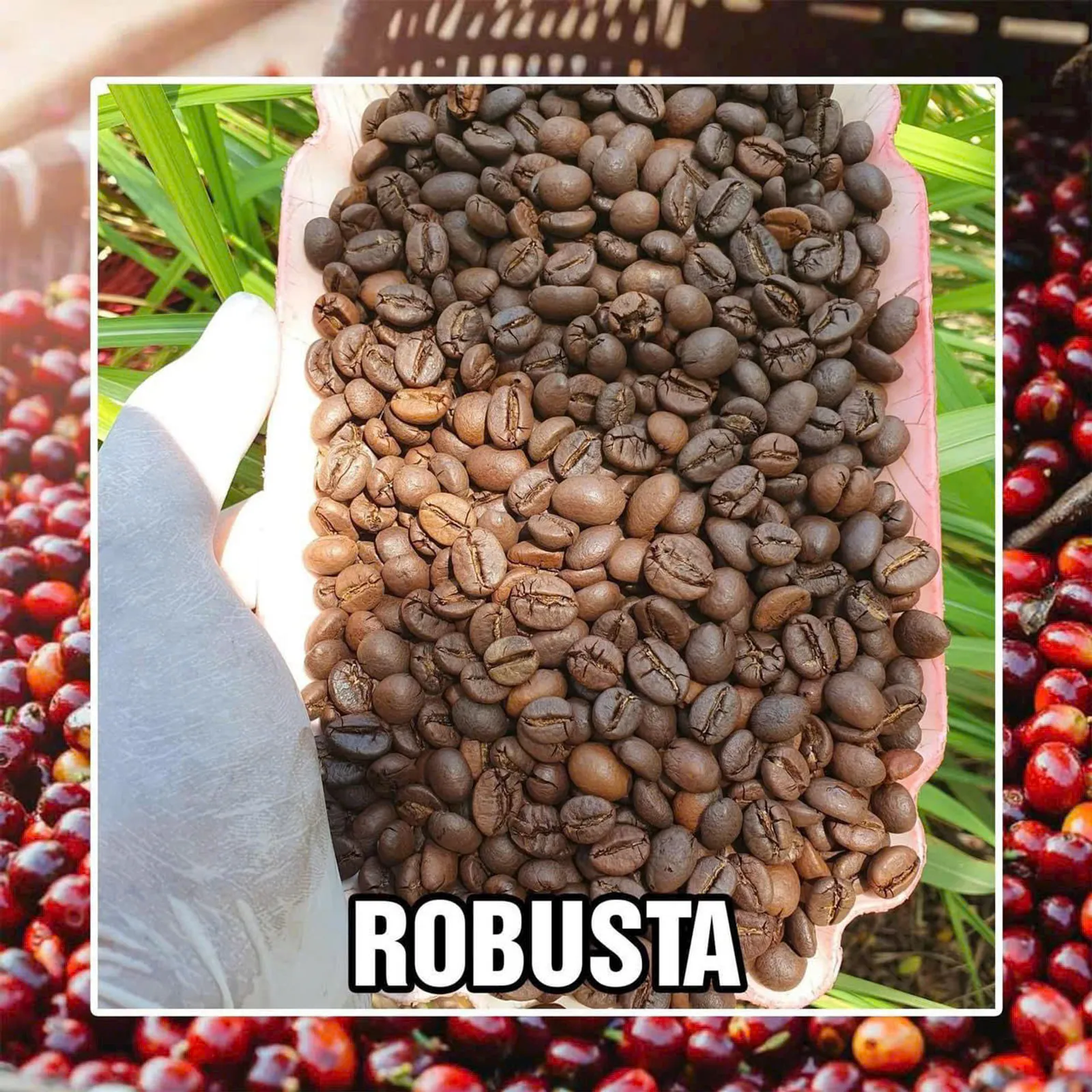
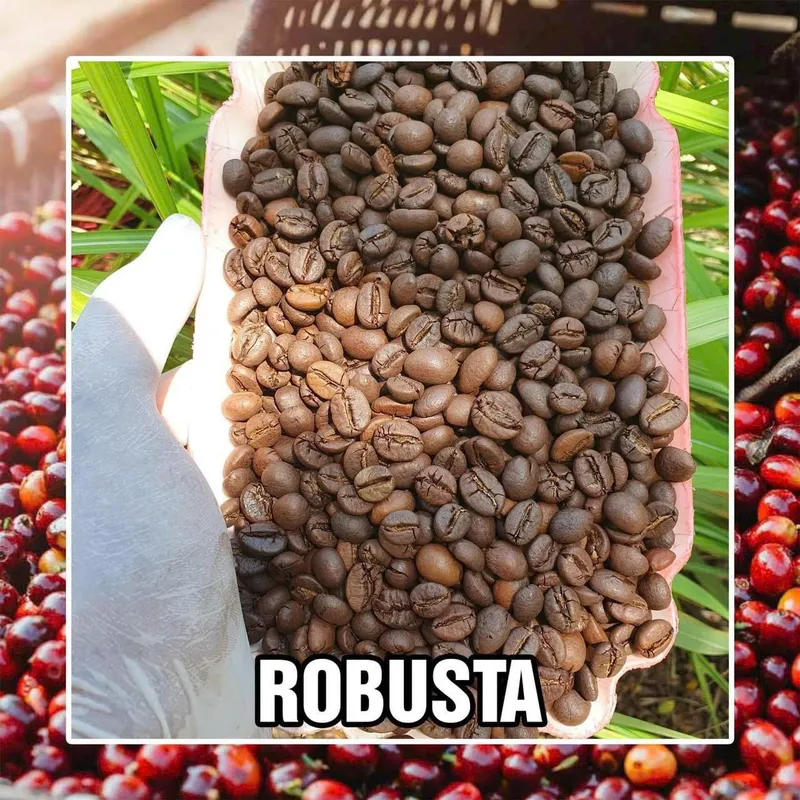
Vietnam robusta green coffee beans — Grade 1 Screen 18

Grade 1 Screen 18 Color Sorted green beans — GreenTech export lot, Lam Dong origin

Flavor & Cup Profile

Robusta Flavor Profile

Vietnam Robusta delivers a characteristic cup that forms the backbone of espresso blends, instant coffee, and single-serve formats worldwide.

Body

Heavy, full, lingering

▮▮▮▮▮

Acidity

Low — clean, not sharp

▮▯▯▯▯

Bitterness

Pronounced, chocolatey

▮▮▮▮▯

Caffeine

High (~2.7%) — strong extraction

▮▮▮▮▮

Crema

Thick, persistent — ideal for espresso

▮▮▮▮▮

Sweetness

Low — earthy, nutty base

▮▮▯▯▯

Roast Profiles

Light–Medium (200–215°C) Earthy grain notes, mild chocolate, higher caffeine punch. Common in Vietnamese phin filter brewing.
Medium–Dark (215–230°C) Dark chocolate, roasted nuts, caramel undertones. Preferred profile for espresso base blends.
Dark (230–245°C) Intense dark chocolate, smoky, reduced acidity. Used in Italian-style blends for strong body and crema.

Why Roasters Use Robusta

  • Thick, persistent crema in espresso — higher fat and fiber content than Arabica
  • Lower cost per cup — blending 20–40% Robusta reduces blend cost significantly
  • Higher caffeine — boosts the perceived strength of espresso and instant coffee
  • Flavor stability — less aromatic volatility, longer shelf-life after roasting
  • Emulsification — improves mouthfeel and texture in milk-based drinks
Growing Regions

Four Major Growing Regions

Vietnam's Robusta is cultivated across four provinces in the Central Highlands, each with distinct terroir characteristics.

Dak Lak

Đắk Lắk

Largest
Cultivation Area
~210,000 ha
National Share
~30%
Altitude
400–800 m
Annual Rainfall
1,600–1,800 mm/yr
Varieties
Robusta >95%
Harvest Season
Oct – Jan

Dak Lak is Vietnam's coffee heartland. The province produces primarily washed and natural Robusta at lower altitudes, with a long dry season ideal for cherry drying.

Lam Dong

Lâm Đồng

Mixed Origin
Cultivation Area
~175,000 ha
National Share
~25%
Altitude
900–1,500 m
Annual Rainfall
1,750–2,000 mm/yr
Varieties
Robusta 65% · Arabica 35%
Harvest Season
Nov – Mar

Lam Dong is Vietnam's highest-altitude coffee region, producing both Robusta and Arabica. Its cooler climate yields cleaner, brighter Robusta with less earthy intensity.

Dak Nong

Đắk Nông

High Rainfall
Cultivation Area
~130,000 ha
National Share
~20%
Altitude
500–1,000 m
Annual Rainfall
2,200–2,600 mm/yr
Varieties
Robusta >98%
Harvest Season
Oct – Jan

Dak Nong benefits from the highest rainfall of the four regions, producing dense beans with higher moisture at harvest — careful drying is essential for export quality.

Gia Lai

Gia Lai

Growing
Cultivation Area
~100,000 ha
National Share
~15%
Altitude
500–900 m
Annual Rainfall
2,000–2,400 mm/yr
Varieties
Robusta >98%
Harvest Season
Oct – Jan

Gia Lai is an expanding Robusta region with significant investment in processing infrastructure, producing reliable G1 S16 and S18 grades.

Processing Methods

How Vietnam Robusta Is Processed

Processing method directly affects cup quality, moisture stability, and grade classification.

Natural (Dry) Process

~70%

Process Steps

Cherry → Sun-dry on raised beds 15–25 days → Hull → Mill → Grade → Export

Cup Result

Earthy, heavy body, low acidity. Most common for G1 S16, G2 FAQ grades.

G1 S18, G1 S16, G2 FAQ

Dak Lak, Gia Lai, Dak Nong

Washed (Wet) Process

~20%

Process Steps

Cherry → Pulp → Ferment 24–48h → Wash → Dry 8–12 days → Hull → Grade → Export

Cup Result

Cleaner cup, reduced earthiness. Preferred for premium G1 S18 Color Sorted lots.

G1 S18 Color Sorted

Lam Dong, Dak Nong

Honey / Semi-washed

~10%

Process Steps

Cherry → Pulp (mucilage retained) → Dry 12–18 days → Hull → Grade → Export

Cup Result

Balanced sweetness, medium body. Used for specialty-position G1 S18 CS micro-lots.

G1 S18 CS specialty

Lam Dong premium mills

Grade Reference

Vietnam Robusta Export Grades

All grades certified under TCVN 4193:2014. SGS pre-shipment inspection included with every GreenTech export lot.

Grade Screen Black Beans Moisture Primary Use Tier
G1 S18 Color Sorted S18 ≥ 90% ≤ 0.2% ≤ 12% Branded espresso blends, specialty roasters Premium
G1 S18 Cleaned S18 ≥ 90% ≤ 0.5% ≤ 12.5% Commercial espresso, premium instant High
G1 S16 Color Sorted S16 ≥ 90% ≤ 0.2% ≤ 12% Espresso blends, quality instant coffee High
G1 S16 Cleaned S16 ≥ 90% ≤ 0.5% ≤ 12.5% Standard commercial blends, soluble processing Standard
G2 FAQ S13 ≥ 90% ≤ 2% ≤ 12.5% Soluble processing, low-cost blend base Bulk
Culi (Peaberry) Peaberry ≤ 0.2% ≤ 12% Specialty single-origin, pour-over, Vietnamese phin Specialty
Commercial Applications

How Vietnam Robusta Is Used

Vietnam Robusta serves multiple end markets, from commodity blending to specialty single-origin roasting.

~45% of volume

Espresso Blend Base

Robusta contributes crema, body, and caffeine strength to espresso blends. Most Italian and commercial espresso blends use 20–40% Robusta.

~30% of volume

Instant Coffee

Vietnam is the world's largest Robusta supplier to instant coffee manufacturers. High soluble solids yield makes it ideal for spray-drying and freeze-drying.

~10% of volume

Ready-to-Drink (RTD)

Canned and bottled coffee products in Asia use high-caffeine Robusta as the base. Heavy body and crema-forming properties suit cold and hot RTD formats.

~8% of volume

Vietnamese-Style Coffee

Vietnam's domestic market consumes significant volumes of domestic-roasted Robusta for phin filter brewing — a high-extraction, sweetened cold or hot format.

~4% of volume

Single-Origin Specialty

Premium G1 S18 Color Sorted and Culi (peaberry) grades are increasingly used by specialty roasters exploring high-quality Robusta as a deliberate origin choice.

~3% of volume

Coffee Pods & Capsules

Robusta's high extraction yield and crema properties suit pressurized capsule formats. Used in blends for Nespresso-compatible and ESE pod products.

Robusta vs Arabica

Vietnam Robusta vs Arabica: Key Differences

Understanding the structural differences helps buyers make informed sourcing decisions.

Vietnam Robusta Arabica
Species Coffea canephora Coffea arabica
Caffeine ~2.7% ~1.5%
Body Heavy, full Medium, clean
Acidity Low Medium–High
Bitterness High Low–Medium
Growing altitude 400–1,500 m 900–2,200 m
Disease resistance Resistant Susceptible
Yield per hectare 2–4× higher Lower
Price (relative) 30–40% lower Higher
Primary use Blends, instant, espresso Single origin, filter, specialty

Vietnam also produces high-altitude Arabica in Lam Dong and Son La provinces.

Market Position

Vietnam in the Global Coffee Market

#1

Robusta exporter globally

#2

Overall coffee exporter (all origins)

>40%

Of global Robusta supply

640K+

Smallholder farming households

Vietnam's rise as a coffee powerhouse began in the 1990s with government-led expansion of the Central Highlands. Today, the country exports over $4 billion of coffee annually — second only to Brazil in total volume.

The overwhelming majority of Vietnam's production is Robusta, concentrated in Dak Lak, Lam Dong, Dak Nong, and Gia Lai provinces. More than 640,000 smallholder farming families participate in the supply chain.

Price-wise, Vietnam Robusta trades at a discount to ICE Robusta futures (LIFFE). GreenTech publishes monthly market intelligence reports covering current differentials, crop estimates, and port availability.

FAQ

Frequently Asked Questions

What grades of Vietnam Robusta does GreenTech export?

We export G1 Screen 18 Color Sorted, G1 Screen 18 Cleaned, G1 Screen 16 Color Sorted, G1 Screen 16 Cleaned, G2 FAQ, and Culi (peaberry). All lots are SGS inspected pre-shipment. Contact us for current availability and pricing.

What is the minimum order quantity (MOQ)?

Our standard MOQ is one 20-foot FCL, approximately 19–21 metric tonnes depending on grade and packaging. We can discuss smaller trial orders for new buyers.

What certifications and documents are included with each shipment?

Each shipment includes: SGS pre-shipment inspection report, phytosanitary certificate (MARD), certificate of origin (Form B or EUR.1), ISO 22000:2018 documentation, and EUDR due diligence files where required.

What is the lead time for export?

Standard lead time is 15–25 days from order confirmation to vessel loading at Cat Lai port. Transit times: 20–25 days to European ports, 18–22 days to US West Coast, 7–10 days to Northeast Asia.

Is Vietnam Robusta EUDR compliant?

Yes. All GreenTech lots are sourced from registered farms with documented geolocation, land title, and deforestation-free verification aligned with EU Deforestation Regulation requirements. We provide full due diligence documentation per shipment.

Can I request a coffee sample before placing an order?

Yes — we offer 200g roasted samples and 500g green bean samples for qualified buyers. Contact us with your company details and target grade specifications.

Source Vietnam Robusta Directly

GreenTech exports Grade 1 Screen 18 and Screen 16 Robusta from Lam Dong and Dak Nong. SGS inspected, EUDR ready, FOB Cat Lai.

ISO 22000:2018SGS InspectedEUDR ReadyFOB Cat Lai