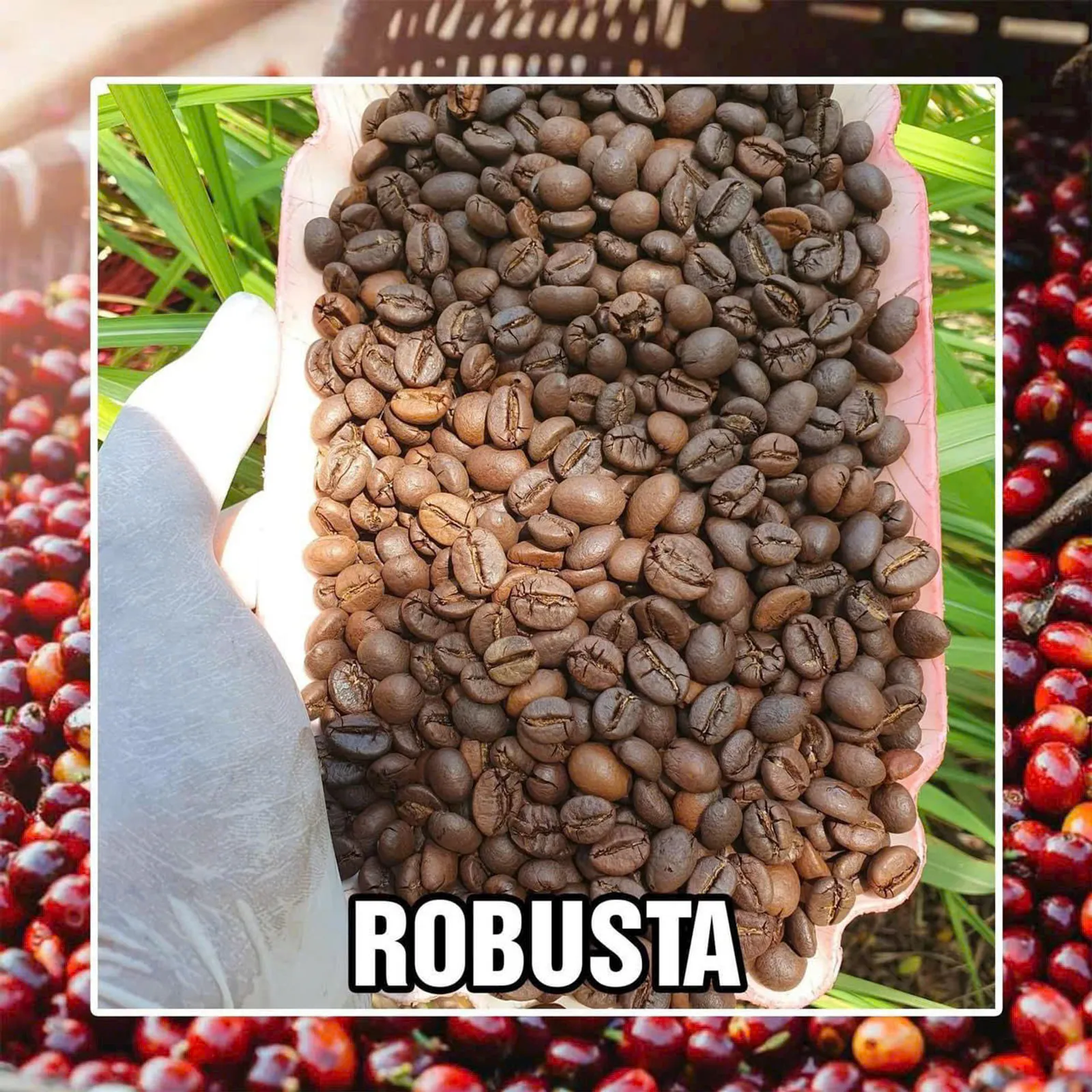
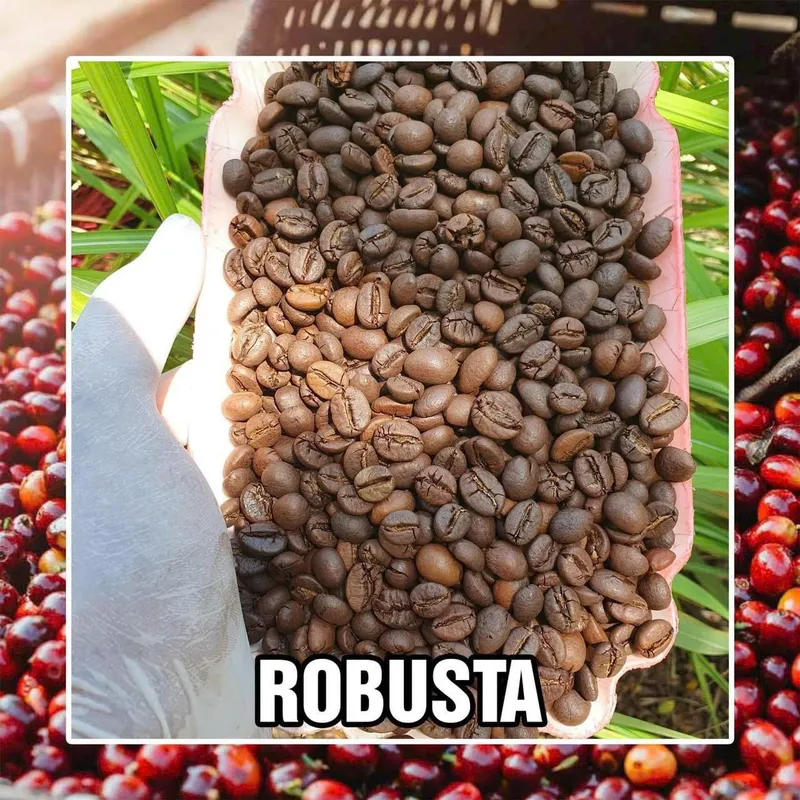
Vietnam robusta green coffee beans
World's #1 Robusta Origin40%+ Global SupplyCentral HighlandsCoffea canephora

Vietnam Robusta Coffee

Vietnam is the world's largest robusta producer — over 40% of global supply grown across 600,000+ hectares of volcanic Central Highlands soil. A complete guide to origins, flavor, grades, and why buyers worldwide rely on Vietnamese robusta.

>40%

Global robusta share

1.6M MT

Annual production

600K ha

Cultivation area

4 Provinces

Central Highlands

The Coffee

What Is Vietnam Robusta Coffee?

Vietnam robusta coffee is Coffea canephora grown in the Central Highlands of Vietnam — a plateau region covering Dak Lak, Lam Dong, Dak Nong, and Gia Lai provinces, 400–1,500 metres above sea level on deep volcanic red basalt soil.

The Central Highlands climate — two distinct seasons, 1,600–2,600 mm of annual rainfall, and temperatures averaging 20–25°C — is ideal for robusta. The species naturally thrives at lower altitudes than arabica, produces higher yields per hectare, and is significantly more resistant to coffee leaf rust and other diseases.

Vietnam began large-scale robusta cultivation in the 1980s and reached dominance by the 2000s. Today, Vietnam exports over 1.5 million metric tons of coffee annually — over 95% of it robusta — making it the world's largest robusta supplier and second-largest coffee exporter overall after Brazil.

Vietnam robusta green coffee beans — Grade 1 Screen 18

Grade 1 Screen 18 Vietnam Robusta — Lam Dong origin

Sensory Profile

Vietnam Robusta Flavor Profile

Robusta's defining sensory traits make it irreplaceable in commercial blending and instant coffee production.

Body

Full / Very Full

▮▮▮▮▮

Acidity

Very Low

▮▯▯▯▯

Bitterness

High

▮▮▮▮▯

Caffeine

~2.7% (vs 1.5% arabica)

▮▮▮▮▮

Crema

Thick & Persistent

▮▮▮▮▮

Sweetness

Low

▮▮▯▯▯

Tasting Notes by Roast Level

Light Roast Rubber, green wood, peanut, grain — rarely used alone
Medium Roast Dark chocolate, cocoa, earthy, mild smoke, woody base
Dark / Espresso Roast Rich bittersweet chocolate, char, full body, thick persistent crema

Why Buyers Blend Robusta

  • Higher caffeine content increases energy perception per cup
  • Thick crema in espresso — essential for traditional Italian espresso
  • Strong body holds up through milk in cappuccinos and lattes
  • Lower cost per kilo extends arabica-heavy blends economically
  • Solubility in hot water — critical for instant coffee extraction
Central Highlands

Vietnam Robusta Growing Regions

Four provinces form the core of Vietnam's robusta belt. Each has distinct altitude, soil, and buyer profile.

Dak Lak

Đắk Lắk

Coffee Capital
Area
~210,000 ha
National share
~30%
Altitude
400–800 m
Rainfall
1,600–1,800 mm/yr
Varieties
Robusta >95%
Harvest
Oct – Jan

Buon Ma Thuot is Vietnam's coffee capital — strongest processing infrastructure, most competitive spot pricing, reliable year-round availability.

Lam Dong

Lâm Đồng

High-Altitude
Area
~175,000 ha
National share
~25%
Altitude
900–1,500 m
Rainfall
1,750–2,000 mm/yr
Varieties
Robusta 65% · Arabica 35%
Harvest
Nov – Mar

Highest altitude robusta in Vietnam. Denser beans, tighter natural defect tolerance. Dalat origin recognized by global specialty buyers.

Dak Nong

Đắk Nông

Volume Origin
Area
~130,000 ha
National share
~20%
Altitude
500–1,000 m
Rainfall
2,200–2,600 mm/yr
Varieties
Robusta >98%
Harvest
Oct – Jan

Fastest-growing coffee province. High rainfall produces large, heavy beans. G Gia Nghia logistics hub.

Gia Lai

Gia Lai

Scale Origin
Area
~100,000 ha
National share
~15%
Altitude
500–900 m
Rainfall
2,000–2,400 mm/yr
Varieties
Robusta >98%
Harvest
Oct – Jan

Consistent classic robusta profile at competitive pricing. Pleiku logistics hub with Quy Nhon port access.

Post-Harvest

Processing Methods

Processing method determines moisture content, defect rate, and ultimately cup profile. Vietnam uses three main approaches.

Dry / Natural

~70% of volume

Process

Cherries dried whole on raised beds or paved yards for 2–4 weeks

Cup result

Earthy, full body, slightly fermented sweetness, lower cost

G1 S18, G1 S16, G2 FAQ

Dak Lak, Gia Lai, Dak Nong

Wet / Washed

~20% of volume

Process

Pulp removed, beans fermented 24–36 hrs, washed, dried on raised beds

Cup result

Cleaner cup, lower defects, more consistent moisture — preferred by specialty buyers

G1 S18 Color Sorted primarily

Lam Dong (Dalat), select Dak Nong

Honey / Semi-Washed

~10% of volume

Process

Pulp removed but mucilage left on during drying

Cup result

Balanced — cleaner than natural, more body than washed, mild sweetness

G1 S18 CS specialty lots

Lam Dong premium mills

TCVN 4193:2014

Vietnam Robusta Export Grades

All export grades follow Vietnam national standard TCVN 4193:2014. Screen size and defect tolerances determine grade classification and price premium.

Grade Screen Black Beans Moisture Primary Use Tier
G1 S18 Color Sorted S18 ≥ 90% ≤ 0.2% ≤ 12% Specialty espresso, branded blends Premium
G1 S18 Cleaned S18 ≥ 90% ≤ 0.5% ≤ 12.5% Commercial espresso, premium instant High
G1 S16 Color Sorted S16 ≥ 90% ≤ 0.2% ≤ 12% Espresso blends, quality instant High
G1 S16 Cleaned S16 ≥ 90% ≤ 0.5% ≤ 12.5% Standard commercial blends Standard
G2 FAQ S13 ≥ 90% ≤ 2% ≤ 12.5% Bulk soluble coffee, low-cost base Bulk
Culi (Peaberry) Peaberry ≤ 0.2% ≤ 12% Single-origin, Vietnamese phin Specialty
Applications

How Vietnam Robusta Is Used

Robusta's high caffeine, body, and crema make it essential across multiple coffee product categories.

20–30% robusta

Commercial Espresso Blends

Italian and European espresso traditions use robusta to build crema, body, and caffeine content. G1 S18 CS and G1 S18 Cleaned are standard blend grades.

60–80% robusta

Instant & Soluble Coffee

Robusta's higher soluble solids content and water extractability make it the primary base for spray-dried and freeze-dried instant coffee globally.

40–60% robusta

Ready-to-Drink (RTD) Coffee

RTD cold brew and canned coffee rely on robusta for strong flavor that survives dilution, chilling, and extended shelf life.

100% robusta or Culi

Vietnamese Phin Filter Coffee

Traditional Vietnamese drip coffee (cà phê phin) uses dark-roasted robusta for its signature bitter-rich profile, often served with condensed milk.

10–25% robusta

Capsule & Pod Coffee

Espresso pod systems use robusta for crema formation and consistent extraction pressure. Culi (peaberry) lots are preferred for premium pods.

G1 S18 CS lots

Single-Origin Specialty

Growing demand from specialty roasters for traceable single-origin robusta. Lam Dong high-altitude lots (900–1,500 m) lead this segment.

Comparison

Vietnam Robusta vs Arabica

The two species serve different purposes. Understanding the difference helps buyers choose the right blend ratio.

Attribute Robusta Arabica
Species Coffea canephora Coffea arabica
Caffeine ~2.7% ~1.5%
Body Very full, thick Medium to full
Acidity Very low Medium to high
Bitterness High Low to medium
Growing altitude 400–1,500 m 900–2,200 m
Disease resistance High Low
Yield per hectare High (2–4 MT) Lower (1–2 MT)
Price (relative) Lower Higher
Primary use Espresso base, instant, RTD Specialty, filter, pour-over

Vietnam also produces Arabica at altitude in Lam Dong province. See origins guide →

Global Context

Vietnam in the Global Robusta Market

#1

World's largest robusta producer

#2

Total coffee exporter globally

>40%

Share of global robusta supply

640K+

Smallholder farms

Vietnam's rise to robusta dominance was driven by the Central Highlands Renovation Program of the 1980s–90s, which converted highland forests to coffee cultivation at scale. The government, VICOFA, and international development partners supported infrastructure, processing technology, and export certification.

Today, Vietnam robusta is traded on the London International Financial Futures Exchange (LIFFE) under the Robusta Coffee futures contract. ICO composite robusta prices and local differential premiums (vs. London) determine FOB pricing at Cat Lai Port, Ho Chi Minh City.

Key importing markets include Germany, Italy, Spain, Japan, South Korea, and the United States — primarily for instant coffee manufacturing and commercial espresso blending. Emerging demand from Middle Eastern and Southeast Asian RTD coffee markets is growing.
FAQ

Vietnam Robusta Coffee — Frequently Asked Questions

What makes Vietnam robusta coffee different from other origins?

Vietnam robusta grows in the Central Highlands at 400–1,500 m altitude on volcanic red basalt soil with 1,600–2,400 mm of annual rainfall. This terroir produces dense beans with higher caffeine (~2.7%), stronger body, and an earthy, chocolate bitterness prized in espresso blends and instant coffee.

What are the main grades of Vietnam robusta?

Under TCVN 4193:2014: G1 Screen 18 Color Sorted (premium), G1 S18 Cleaned, G1 Screen 16 Color Sorted, G1 S16 Cleaned, G2 FAQ (bulk), and Robusta Culi (peaberry specialty). G1 S18 CS is the highest export grade.

How much robusta does Vietnam produce?

Vietnam produces approximately 1.5–1.7 million metric tons of coffee per year — over 40% of global robusta output. Central Highlands cultivation covers over 600,000 hectares across four provinces.

What is Vietnam robusta used for?

Primarily commercial espresso blends (crema and body), instant and soluble coffee manufacturing, ready-to-drink (RTD) coffee, and traditional Vietnamese phin filter coffee. High-grade G1 S18 CS is increasingly used for single-origin specialty robusta.

What does Vietnam robusta taste like?

Bold, full body with earthy and woody base notes, dark chocolate and cocoa bitterness, very low acidity, and thick persistent crema in espresso. Caffeine content (~2.7%) is nearly double arabica. Dry-processed lots have mild fermented sweetness; washed lots are cleaner and more consistent.

Which province produces the best Vietnam robusta?

Dak Lak (Buon Ma Thuot) leads in volume and processing infrastructure. Lam Dong (Dalat) produces the highest-altitude robusta in Vietnam (900–1,500 m) with denser beans and lower defect rates — preferred by specialty buyers. Dak Nong and Gia Lai offer volume at competitive FOB pricing.

Source Vietnam Robusta Direct

GreenTech exports G1 and G2 Vietnam robusta from Lam Dong and Dak Nong — 500 MT/month capacity, SGS pre-shipment inspection, FOB Cat Lai. Container-load MOQs from 19 MT.

ISO 22000:2018SGS InspectedEUDR ReadyFOB Cat Lai